
2026 School Deliberative Session
All but tax cap warrant article going to ballot as written

The School Deliberative Session was largely uneventful except for the discussion on the citizen-petitioned warrant article for a tax cap. I did not get an attendance count, but my estimate was about 110, with many people arriving after the session began.
If the operating budget and all the warrant articles are approved by the voters, this will increase taxes by 2.1%
Except for the tax cap, all warrant articles were moved to the ballot as written. The tax cap is sure to be a highly contentious issue this election season. The Nottingham Blog will publish an article focusing on the issue prior to the election.
Tax Cap - #10
The sponsor of the tax cap warrant article presented a chart showing that while Nottingham’s municipal spending had for 20 years roughly tracked inflation (as measured by the Consumer Price Index), the school’s spending had greatly outpaced inflation. He claimed that the resulting tax increases had put residents at risk of losing their homes.
He praised the town’s municipal tax cap for helping make this possible and urged that a tax cap be applied to the school to more strongly incentivize efficiency. He said it would give the school more leverage in collective bargaining.
Budget Committee Chairman Owen Friend-Gray said that the Budget Committee doesn’t support the tax cap warrant article because it could prevent the school from doing things it is legally mandated to do. Many others spoke against the warrant article, including School Board members, Budget Committee members, and candidates for office. Much of their ire was directed at the state government for failing to fund local schools and for legislation that enabled this warrant article.
By statute, the voters at the deliberative session had little flexibility for amending the warrant article. Two amendments were approved. One corrected an error. This warrant article requires a 3/5ths supermajority to pass, not a majority.
Another amendment changed the inflation metric from the Consumer Price Index to the Municipal Cost Index, arguing that it better reflected the inflation rate for the goods the school purchased. The sponsor argued that this was a change in intent and should be disallowed because the intent was to control spending based on taxpayers' ability to afford it, not on the school’s inflation experience. The school attorney said that by statute, this amendment was permissible.
Operating Budget - #2
The proposed operating budget is 3.0% higher than last year’s budget. The default budget is 1.9% higher than last year’s budget.
Major factors in the proposed operating budget include large cost increases in health insurance - ranging from 8.8% to 15.7%, depending on role - and the addition of an additional 5th-grade teacher.
Repairs to the school’s heating system were completed over the summer. The system has been functioning correctly this winter.
School Expansion - #7
The School Board expects enrollment to continue increasing, and the school lacks sufficient instructional space. They also said that since the school was built, they’ve had to include pre-K and full-time kindergarten, which confuses the enrollment numbers. They also noted that voters have rejected two prior attempts to expand the school.
A citizen pointed out that current enrollment is 529; in 2016, it was 524; and 20 years ago, it was 514. There was no response from the School Board on this issue.
Collective Bargaining - #3
A citizen attempted to amend the warrant article to make clear that the annual pay increases were cumulative, and that the town had voted to make collective bargaining negotiations public, and that the school had not complied. The school’s attorney said that by statute, the wording could not be changed and that collective bargaining could not be made public.
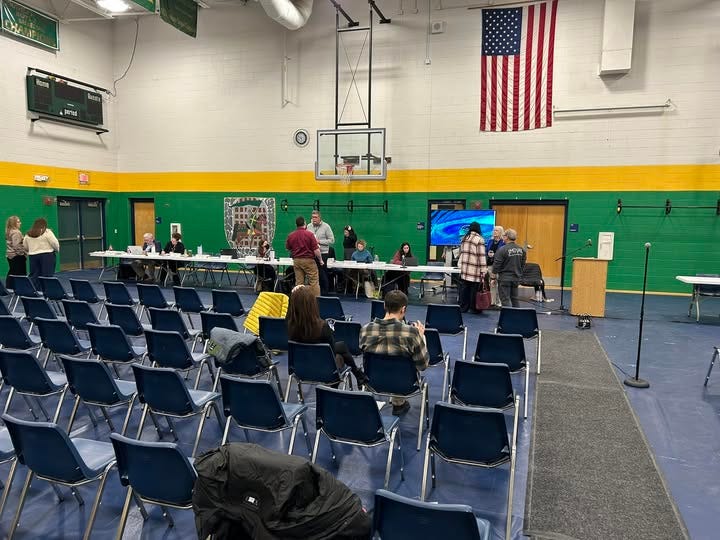
The photo included with this blog was taken well before the meeting started and does not represent the attendance accurately.